
Productivity Hacks Can't Overcome Bad Policies
We have to stop blaming individual workers for systemic inefficiencies

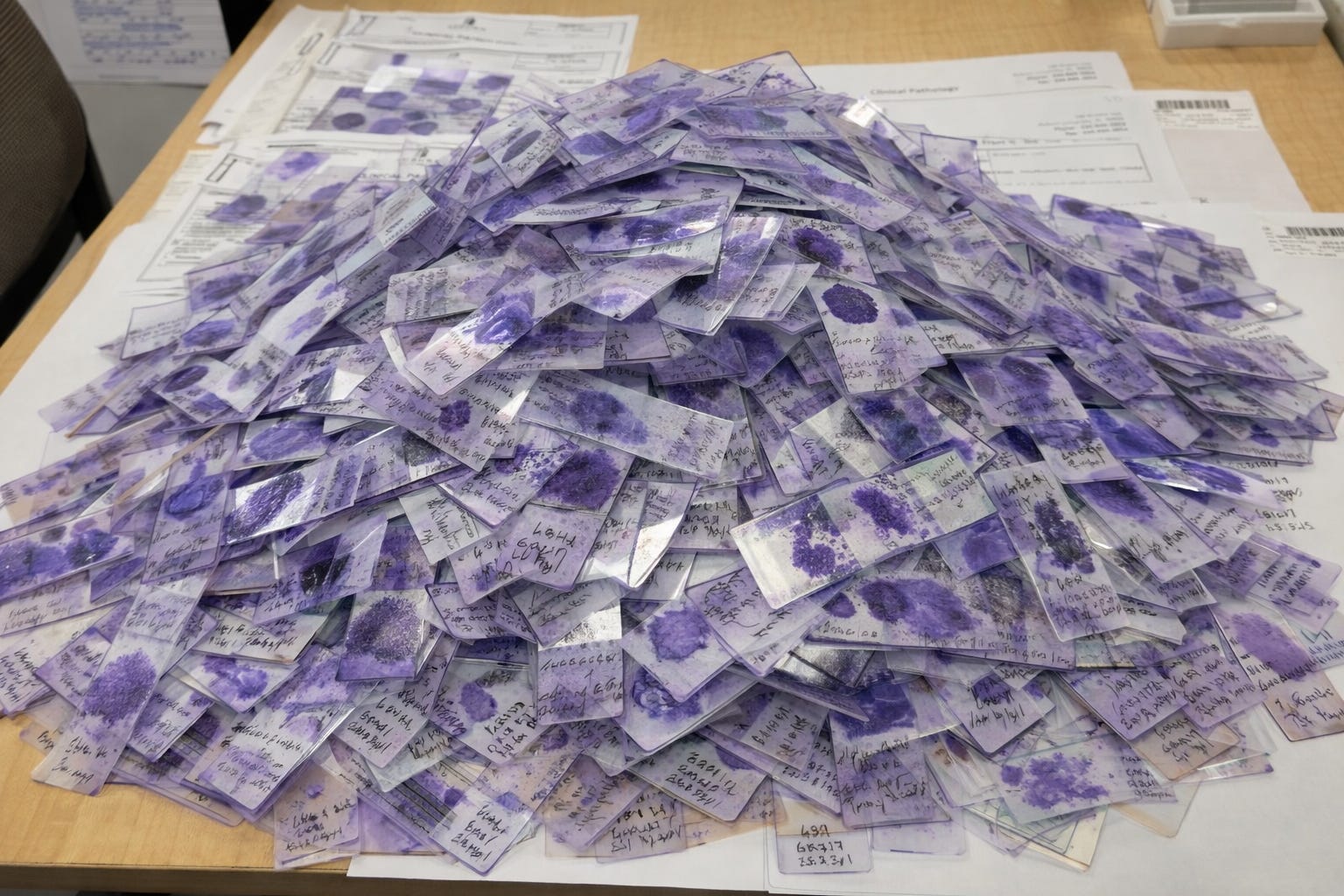
The other day I saw a post on LinkedIn asking pathologists to share productivity tips to improve their efficiency. People discussed macros, dictation, and other workflow hacks. Some even brought up using AI. Everyone in the conversation meant well and wanted to help others save time during their work day. Yet all I could think about was a pathologist friend who recently mentioned to me that they were behind that day because they were reviewing a bone marrow aspirate sample with 32 slides.
Thirty two!
Why so many? Because their lab, like many I’ve worked for over the years, does not have a limit on how many slides hospitals can submit. When I worked at Auburn and IDEXX, it was common to review hundreds of slides a day. It’s not hard to arrive at the number: Minimum caseload benchmarks are often 40-50 cases a day, and if every case had only 3 slides—many cases had more—you’d be looking at 120-150.
It’s worth pointing out that such high caseloads would literally be illegal in the world of human medicine (at least in the US)—Regulations published by the Centers for Medicare and Medicaid Services cap the number of cytology slides evaluated every day at 100:
“The maximum number of slides examined by an individual in each 24-hour period does not exceed 100 slides (one patient specimen per slide; gynecologic, nongynecologic, or both) irrespective of the site or laboratory. This limit represents an absolute maximum number of slides and must not be employed as an individual’s performance target.” (emphasis mine)
Let’s imagine how long that 32 slide bone marrow case would take to review: If you spent only a minute on each slide (which is not a lot of time for such a complex tissue), it would take over half an hour to look at everything before even drafting the report, and that’s not counting any time it would take to look up any references or contact the clinician to discuss the case.
Now consider that veterinary pathologists working in high-volume labs have an average turnaround time (TAT) per case that is well under 10 minutes! Management does everything it can to reduce TAT and slower pathologists may get in trouble. Can you see the problem here? We have an unrealistic expectation for throughput butting up against a policy choice that makes it almost impossible to meet.
The end result?
Frustration in the short term, burnout long term.

Submitting unlimited slides is by no means the only common lab policy that drags efficiency down. Many labs require little to no clinical data when submitting cases. Like slide caps, it is because they don’t want to add any “friction” to their actual customers, referring veterinarians. However, this can lead to delays in case handling when there is not enough information to make a diagnosis, and you have to call or email the vet for answers that should have been originally provided. Ditto for when a client calls in after a report is finalized to say “Oh, by the way, I should have mentioned X, could that change your interpretation?” which usually triggers going back to slides to look again and then editing the report.
Many labs are increasingly using slide scanners to digitize slides and send them to specialists all over the world. This can improve TAT by allowing instant consultation with colleagues across the globe, balance caseloads that vary between regions, and allow diversion when one lab is impacted by disruptions from weather, illness, power outages, etc. It usually works great for histopathology slides, which are fixed tissues cut to a uniform thickness. Cytology smears, on the other hand, are very uneven globs of cells and fluid, which can cause problems with image focus and lead to a higher rate of non-diagnostic cases. This is just a limitation of the current technology, and the most appropriate way to handle is rejecting those cases either for re-scanning or shunting to a pathway of review on a regular light microscope. Unfortunately, many managers pressure pathologists into reading out as many suboptimal cases as possible to make their metrics look superficially better.
For another example, pathologists in some labs face extremely high standards for quality. In the abstract, this sounds like a good thing. The problem is when this bar is unreasonably strict. There is one organization that holds pathologists to an error rate of less than one in more than a years’ worth of cases! What do you think such a standard does? It makes you spend extra time, time you don’t have, trying to rule out rare findings like a lone infectious organism as a CYA. This problem is compounded by the ones discussed earlier (excess slides, digital image quality issues).

Now, I want to zoom out beyond just pathology. I’ve worked in clinical practice off and on since graduation in 2012, and counterproductive policies impact workers there, too.
Working relief shifts over the past year, my appointment slots are often double or triple booked. This inevitably leads to delays, which stresses out the vets and techs providing care and sets up pet owners for frustration.
Short-staffing exacerbates the problem. Sometimes this is unavoidable due to people calling in sick or with last minute emergencies, but there is often not a lot of urgency around filling those gaps. On one recent busy shift, we were down 50% of the number of technicians that were supposed to be scheduled. By some miracle we got through it on time, but it was a rough experience I wouldn’t want to repeat.
Computerized metrics to micromanage workflow are another pain point. It’s becoming increasingly common to have software that tracks patients in and out of rooms down to the second. Ostensibly this data is supposed to promote shorter wait times for clients and to inform staffing practices; in practice, it mostly results in getting reprimanded if you fall behind.
Finally, there is the big, bad, bane of every doctor’s existence: charting and paperwork. Documentation expectations only go one direction: up, Up, UP! In the “old days,” a simple hand-written “SOAP”1 progress note would suffice for each encounter. Today, every visit is accompanied by a slew of digital intake forms, boxes to check, dropdown menus for diagnoses, duplicative entries for billing, separate discharge instructions, and more. It should not be surprising that one study in human medicine found doctors spent almost as much time on electronic records as patient care, and those software systems were cited as a top reason for burnout in another study.

As I was brainstorming the ideas for this post, I read a great piece on LinkedIn about the tension between operations and medical leadership in veterinary companies by Dr. Andy Roark. This part in particular stuck out to me:
“Organizations that are dominated by medical people tend to be inefficient and unfocused. Historically, this has been the norm in veterinary medicine—a fact that highlights the great potential for operational growth today. Conversely, veterinary companies dominated by operations often suffer significant morale and retention problems among medical teams. A number of practice groups last year provided stark examples: they prioritized revenue growth by making operations completely dominant over medicine, quickly losing veterinarians and support staff, which led to closed practices and hastened their demise.”
Andy’s point is that there needs to be balance—no organization will thrive if it prioritizes only medical concerns OR financial/operational ones. There has to be mutual respect and understanding between both domains for the best outcomes for patients, staff, and other stakeholders.
Likewise, I’d say that individual productivity efforts are necessary, but not sufficient, for optimal efficiency and throughput; organizational policies are often overlooked. A good rule of thumb is if everyone is struggling with the same problem, it is probably more of a policy issue than the fault of any specific doctor. To go back to my first example: It doesn’t matter if you find a trick that shaves 30 seconds off your case handle time if you are buried under 30 slides that will take you half an hour to review.
I would go even further and suggest that pinning efficiency problems exclusively on individuals is a toxic morale killer that contributes to the burnout in veterinary (and human) medicine that puts so much pressure on staffing in the first place. We need to do better to maintain a healthy profession.
—Eric
The acronym stands for “Subjective,” “Objective,” “Assessment,” and “Plan,” and summarize the medical thought process from initial impressions to hard data, working diagnosis, and next steps for testing and treatment.
It was a constant struggle. Upper management demanded a 10% increase in productivity each year. I fought it saying that case reports are piece work. Then I rejoiced when a pathologist finally made it into upper management thinking that they would value and represent the professional staff. I was totally wrong. Pathologist are trained to be conformists and have no management experience.
Did you ever wonder how a pathologist could be right all of the time? Less than 1 error per year? It is because of no quality assurance. The only feedback occurs when a client complains and a client has a vested interest in not complaining in front of his own client/pet owner. Even if a case goes for review the reviewer bends over backwards to shield their associate from draconian management. Looking at VLA cytology reports there was only about 80-90% agreement between pathologists. Saying that pathologists are diagnostic demigods is marketing.
This reads like classic ops math. Inputs unbounded, outputs tightly measured. That gap doesn’t get solved by “work faster,” it gets solved by constraints, triage and quality thresholds. If you don’t define the max, the system will always punish the human